Beyond the TIME_WAIT Cliff: Scaling N8N Egress Velocity with Envoy Sidecar
Eliminate EADDRNOTAVAIL errors and pod crashes in high-throughput N8N pipelines. Learn how to tune Kubernetes TCP stacks and implement Envoy sidecar proxies for 7.5x egress velocity
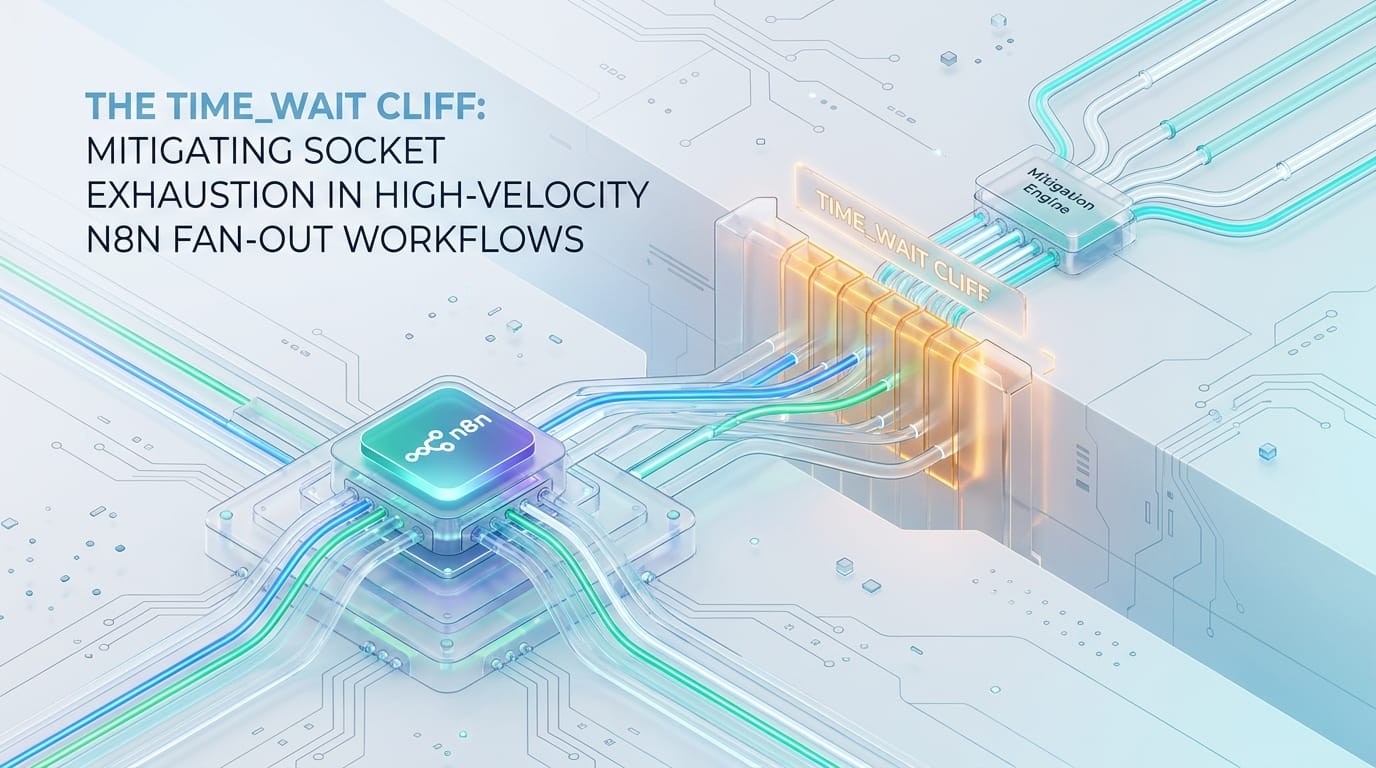
Your N8N worker pods aren’t running out of CPU—they’re suffocating at the transport layer.
When scaling high-throughput automation pipelines to 50,000+ records, standard Node.js HTTP agents collide with the mathematical certainty of the TCP state machine. The result is the dreaded EADDRNOTAVAIL socket exhaustion, triggering cascading infrastructure failures long before your compute capacity is reached. To survive the “TIME_WAIT cliff,” engineering teams must move beyond application logic and embrace OS-level kernel tuning and architectural decoupling via egress offloading.
1. The Core Mechanics of N8N Egress Bottlenecks
To mitigate socket exhaustion, we must first dissect the failure mechanism spanning the V8 JavaScript engine, the libuv thread pool, and the Linux TCP/IP stack.
The V8 / Node.js Execution Context
N8N’s execution engine relies entirely on Node.js’s asynchronous I/O and the underlying libuv thread pool for network operations. Because standard Node.js agents default to an unbounded maximum socket configuration (maxSockets: Infinity) with connection reuse disabled (keepAlive: false), a high-velocity fan-out workflow dictates that every loop iteration must execute a full DNS resolution, a TCP three-way handshake, and a TLS negotiation.
Once the data is transmitted and the HTTP transaction concludes, the connection is actively closed by the client. However, network sockets do not instantly evaporate.
The TIME_WAIT Cliff & Hard Limits
The Linux kernel mandates that all actively closed sockets enter the TIME_WAIT state. As defined by TCP protocol specifications, this state persists to gracefully handle delayed or out-of-order packets from the network, preventing them from bleeding into a newly established connection assigned to the same port.
This introduces rigid mathematical constraints:
Ephemeral Port Limit: Linux systems define available outbound network ports via the net.ipv4.ip_local_port_range parameter. The default range of 32768-60999 yields exactly 28,231 usable sockets.
TIME_WAIT Duration: The lifespan of a socket in this state is governed by net.ipv4.tcp_fin_timeout, which defaults to 60 seconds.
The Exhaustion Threshold: If an N8N worker sustains an egress velocity of >470 requests/second (28,231 sockets / 60 seconds), the underlying OS mathematically exhausts its local port allocation.
At the exact moment the 28,232nd request is fired, the kernel cannot allocate a source port. Subsequent network calls violently fail with the EADDRNOTAVAIL exception. This is Socket Exhaustion. In an N8N environment, this either permanently hangs the Node.js event loop as promises fail to resolve, or triggers a fatal crash of the worker pod, pushing the Kubernetes deployment into a cascading CrashLoopBackOff.
2. Level 1: N8N Environmental & Node-Level Mitigations
Relying on the underlying default Node.js runtime to manage sockets at scale is a well-known anti-pattern. Connection pooling must be explicitly configured and aggressively enforced within the N8N environment.
HTTP Request Node Overrides
Recent iterations of N8N have modernized their HTTP engine, transitioning from axios to node-fetch and got. These updates expose critical underlying agent configurations directly within the node’s UI. For workflows executing high-volume loops, modify the parameters within the HTTP Request node itself:
Enable “Keep Alive” (Options Tab): This forces the underlying HTTP client to maintain and reuse TCP connections across the iteration loop. By bypassing the DNS resolution and TLS handshake overhead on subsequent requests, you drastically reduce egress latency and bypass the creation of new ephemeral ports.
Cap “Max Sockets”: The default limit is 50. In large-scale deployments, unbounded sockets will cause libuv thread pool starvation. You must align the “Max Sockets” parameter with both your upstream API’s rate limits and your specific pod’s CPU allocation. Capping sockets forces the runtime to queue requests locally rather than indiscriminately opening new connections.
Global Runtime & Garbage Collection Tuning
If you are managing older workflow topologies, executing custom webhook callbacks, or running custom code nodes that utilize raw HTTP clients, Node-level overrides are insufficient. You must inject specific environment variables into your worker pods to constrain the Node.js execution environment natively.
# Force Node.js >v19 default keep-alive behavior on the V8 engine layer
NODE_OPTIONS="--http-keep-alive"

# Aggressively prune in-memory workflow state to prevent OOM kills during the batch run
EXECUTIONS_DATA_PRUNE=true
EXECUTIONS_DATA_MAX_AGE=168 # 7 days
EXECUTIONS_DATA_SAVE_ON_PROGRESS=false

# Prevent V8 memory bloat by capping payload buffer allocations per node
N8N_PAYLOAD_SIZE_MAX=16 # Megabyte
These parameters serve a dual purpose. First, forcing --http-keep-alive alters the global agent behavior across the entire engine. Second, executing a 50,000-record fan-out heavily taxes the V8 garbage collector. Disabling EXECUTIONS_DATA_SAVE_ON_PROGRESS prevents database thrashing on every iteration, while N8N_PAYLOAD_SIZE_MAX guarantees that anomalous payload spikes do not fragment the heap. If the Node.js process is overwhelmed by GC pauses, socket timeouts will occur irrespective of your connection pooling strategy.
3. Level 2: OS-Level Kernel Tuning (Kubernetes Worker Nodes)
While application-level pooling mitigates standard workloads, enterprise throughput necessitates aggressive reconfiguration of the underlying Kubernetes node networking stack. Default Linux networking parameters are optimized for generic web traffic, not high-frequency ephemeral egress.
To harden the underlying infrastructure, inject the following sysctl parameters via a privileged DaemonSet or a tightly scoped Kubernetes securityContext.
securityContext:
  sysctls:
    # 1. Expand ephemeral port range to absolute OS maximum (~64.5k ports)
    - name: net.ipv4.ip_local_port_range
      value: "1024 65535"

    # 2. Allow reusing sockets in TIME_WAIT state for new outgoing connections
    - name: net.ipv4.tcp_tw_reuse
      value: "1"

    # 3. Reduce TCP lingering duration from 60s down to 15s
    - name: net.ipv4.tcp_fin_timeout
      value: "15"

    # 4. Expand socket backlog to handle high-concurrency burst queues
    - name: net.core.somaxconn
      value: "8192"
Architectural Rationale:
Expanding ip_local_port_range to 1024 65535 immediately pushes the available socket pool to its absolute maximum.
Setting tcp_tw_reuse allows the kernel to safely reallocate a port currently sitting in the TIME_WAIT state if the new connection’s timestamp is strictly greater than the previous one.
Reducing tcp_fin_timeout from 60 seconds to 15 seconds quadruples the rate at which dead sockets are purged and returned to the ephemeral pool.
Expanding somaxconn to 8192 prevents the kernel from dropping SYN packets during extreme concurrency bursts, smoothing out the traffic spikes inherent to N8N’s batch processing.
4. Level 3: Architectural Decoupling: Local Sidecar Proxy Pattern
The Node.js Garbage Collection Trade-off
Implementing keepAlive directly in Node.js prevents immediate EADDRNOTAVAIL socket exhaustion, but it introduces a secondary bottleneck. The Node.js global agent degrades severely under heavy Garbage Collection pressure when forced to maintain thousands of persistent, multiplexed streams natively. As the V8 heap expands during a large workflow execution, the runtime expends disproportionate CPU cycles managing TCP socket states rather than executing business logic.
Egress Offloading via Envoy
The most resilient architectural pattern for high-velocity N8N topologies is stripping networking responsibilities entirely from the application layer. This is achieved by deploying a sidecar proxy—such as Envoy or Squid—strictly dedicated to egress HTTP connection pooling.
The Mechanism: Instead of the N8N HTTP Request node targeting an external API (e.g., https://api.external-crm.com), it targets the local Envoy sidecar over a local loopback: http://127.0.0.1:10000 (disabling TLS at the application level).
Envoy transparently intercepts this traffic. It handles the computationally expensive TLS termination, manages HTTP/1.1 to HTTP/2 multiplexing, enforces aggressive keep-alive persistence, and handles intelligent upstream retries. N8N becomes a pure execution engine; Envoy acts as the dedicated network multiplexer.
Envoy Egress Configuration Snippet
The following envoy.yaml configuration dictates the Sidecar container’s behavior, capturing discrete local requests and multiplexing them into highly efficient upstream connections.
static_resources:
  listeners:
    - name: n8n_egress_listener
      address:
        socket_address: { address: 127.0.0.1, port_value: 10000 }
      filter_chains:
        - filters:
            - name: envoy.filters.network.http_connection_manager
              typed_config:
                "@type": type.googleapis.com/envoy.extensions.filters.network.http_connection_manager.v3.HttpConnectionManager
                stat_prefix: egress_http
                route_config:
                  name: local_route
                  virtual_hosts:
                    - name: backend
                      domains: ["*"]
                      routes:
                        - match: { prefix: "/" }
                          route: { cluster: upstream_api }
                http_filters:
                  - name: envoy.filters.http.router
  clusters:
    - name: upstream_api
      connect_timeout: 0.25s
      type: LOGICAL_DNS
      dns_lookup_family: V4_ONLY
      lb_policy: LEAST_REQUEST
      # Envoy enforces strict keep-alive and multiplexing here
      upstream_connection_options:
        tcp_keepalive:
          keepalive_probes: 3
          keepalive_time: 30
          keepalive_interval: 5
      load_assignment:
        cluster_name: upstream_api
        endpoints:
          - lb_endpoints:
              - endpoint:
                  address:
                    socket_address: { address: api.external-crm.com, port_value: 443 }
      transport_socket:
        name: envoy.transport_sockets.tls
Notice the upstream_connection_options. Envoy is explicitly instructed to maintain robust, long-lived TCP sessions with the upstream provider. The LOGICAL_DNS cluster type guarantees dynamic resolution of the external endpoint without interrupting the persistent multiplexed streams.
5. Performance Benchmark: Direct Node.js vs. Envoy Sidecar Offloading
To quantify the architectural impact, consider the theoretical engineering model derived from N8N stress tests on a standard 4-vCPU worker pod.
Architectural Pattern | Max Egress Velocity | Upstream TCP Connections | Scaling Implication | Failure Mode |
|---|---|---|---|---|
Scenario A: Direct Node.js (No Tuning) | ~470 RPS | ~28,231 (Ephemeral limit) | Horizontal worker duplication required. Highly inefficient. | EADDRNOTAVAIL Socket Exhaustion |
Scenario B: Envoy Sidecar Offloading | ~3,500 RPS | Strictly 5 (Multiplexed) | Cleanly scales to CPU limits. Maximizes node resource utilization. | CPU/Thread Pool saturation |
In Scenario A, the network stack buckles long before the processor breaks a sweat. By migrating to Scenario B, the Node.js event loop delegates the TCP overhead to a proxy written in C++, utilizing just 5 persistent upstream TCP streams via HTTP/2 multiplexing. The result is a nearly 7.5x increase in throughput, constrained only by the physical compute capacity of the worker pod.
6. Enterprise N8N Optimization
Executing these architectural pivots requires more than just modifying a yaml file; it requires a holistic understanding of how distributed network state impacts business automation. At Azguards Technolabs, we specialize in Performance Audits and Specialized Engineering for enterprise automation stacks.
We do not believe in applying temporary patches to structural engineering problems. When high-velocity workloads trigger protocol-level failures, we step in to architect resilient, scalable systems. From executing deep-dive kernel optimizations to implementing advanced sidecar mesh topologies for N8N, we partner with Principal Engineers to ensure that infrastructure scales transparently beneath your logic.
The TIME_WAIT cliff is an inevitability for any system treating ephemeral network calls as an infinite resource. High-velocity N8N topologies will reliably trigger socket exhaustion when egress velocities cross the mathematical limits of the host OS kernel. By actively overriding the native Node.js HTTP clients, manipulating the Kubernetes networking stack via sysctl security contexts, and ultimately decoupling network I/O through an Envoy sidecar proxy, engineering teams can entirely bypass the >470 requests/second barrier.
Stop allowing kernel connection limits to dictate your application throughput. Contact Azguards Technolabs today for a comprehensive architectural review or to partner with our team on complex, high-throughput N8N implementations.
Would you like to share this article?
Share
Azguards Technolabs
Audit Your Automation Throughput
Stop letting socket exhaustion stall your enterprise pipelines. Our specialized engineering team can audit your N8N topology and implement high-performance sidecar architectures built for massive scale.
Related work

AI & Automation
whatatalk
A WhatsApp inbox, flow builder and commerce platform, built as a multi-tenant product
15 flow node types
A unified WhatsApp inbox, no-code flow builder, catalog and campaign platform built for multi-tenant SaaS.
Related insights

EdTech + Model Fine-Tuning: A Practical Scenario for Support Deflection
Discover how EdTech companies leverage model fine-tuning to significantly reduce support contact volume, improve response times, and deflect common

AI Adoption ROI Gap 2026: Scaling Disconnect Analysis
Explore the AI adoption ROI gap in 2026, analyzing why AI investment is surging while measurable returns stall due to governance and integration

Strata’s 125B AI Inference Engine: What It Changes for Developers
Explore Strata's 125B AI inference engine, enabling large language models on consumer hardware. Understand its impact for local AI development.