PostgreSQL 19: What's New, What Breaks, and When to Upgrade
Explore PostgreSQL 19 new features: concurrent repacking, I/O scaling, parallel autovacuum. Understand breaking changes and assess your PostgreSQL 19
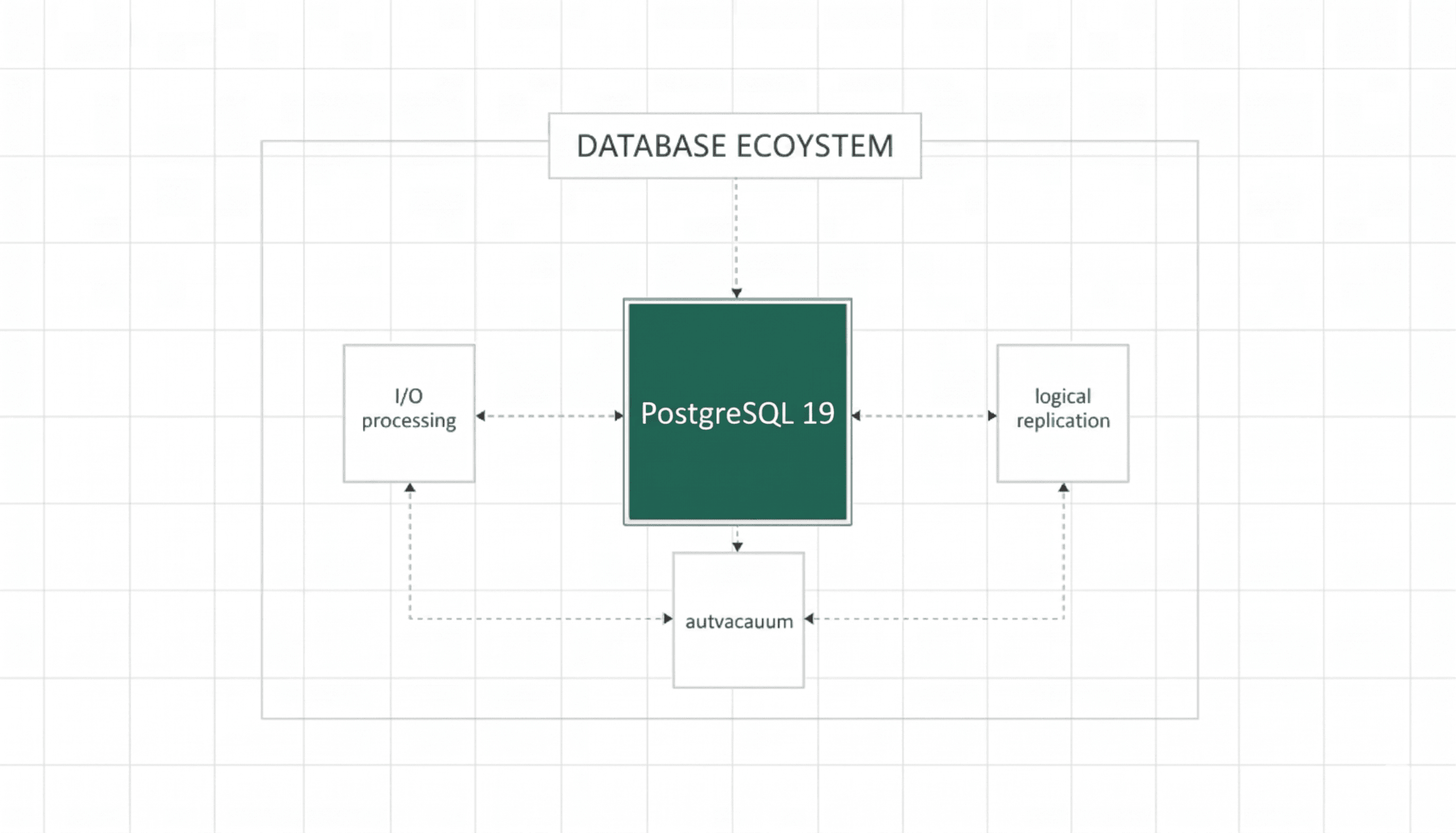
PostgreSQL 19.0 shipped on November 19, 2026, introducing concurrent table repacking, automatic I/O worker scaling, parallel index autovacuum, and read-your-writes consistency on standbys. The release addresses long-standing operational pain points—bloat management, maintenance downtime, and replica-read correctness—but as a four-day-old major version, it carries the standard risks of any fresh database release: untested extension compatibility, potential plan regressions, and unverified behavior across the broader ecosystem of drivers, ORMs, poolers, and managed services.
You need to decide whether PostgreSQL 19 is ready for your production workload now, or whether waiting for broader validation makes more sense. This article explains what changed, which mechanisms drive the improvements, where the maturity limits are, and how to run a staged upgrade without guessing.
PostgreSQL 19: Core Innovations at a Glance
PostgreSQL 19 introduces REPACK and REPACK (CONCURRENTLY) for online table reorganization and space reclamation. The concurrent form reorganizes table storage while allowing normal reads and writes, addressing bloat without blocking application traffic. It still consumes disk, CPU, I/O, WAL, and replication bandwidth—it avoids locks, not resource cost.
Automatic scaling of I/O worker processes adjusts worker count according to workload conditions, potentially improving storage parallelism without manual tuning. Parallel autovacuum of table indexes spreads index vacuum work across multiple workers, reducing the time required to reclaim dead index entries. A new autovacuum prioritization scoring system changes which relations receive vacuum attention first under competing maintenance demand.
Logical replication can now be enabled without a server restart when wal_level is already set to replica, reducing configuration-change downtime. Standby support for read-your-writes consistency helps applications that need reads on replicas to observe recently committed writes, though it requires deliberate routing logic and lag monitoring. "Get or create" behavior combines insertion and retrieval in a single operation, avoiding an application-level network round trip in supported insert-or-retrieve workflows.
The pg_plan_advice extension provides more control over query plan stability and performance, giving operators a mechanism for influencing or documenting planner choices. This matters most for workloads with known plan regressions or strict latency requirements.
Deep Dive: Key Technical Mechanisms Driving PostgreSQL 19
I/O worker auto-scaling adjusts the number of I/O workers dynamically rather than relying entirely on a fixed configuration parameter. The server monitors workload conditions and allocates workers accordingly. This reduces the tuning burden for mixed workloads, but it does not eliminate the need to monitor storage saturation, queue depth, or tail latency—hardware limits still apply.
Parallel index autovacuum distributes index vacuum work across multiple workers on suitable hardware and schemas. This shortens maintenance time for large indexes, but it competes with application traffic for CPU and I/O. You still need to monitor dead tuples, bloat, vacuum duration, worker utilization, and transaction wraparound indicators after upgrading.
Autovacuum scoring prioritizes maintenance work using a scoring mechanism rather than a simple oldest-first or largest-first heuristic. This changes which tables and indexes receive vacuum attention under competing demand. The exact scoring formula is not detailed in the release announcement, so you should validate behavior against your schema and workload rather than assuming optimal defaults.
Concurrent table repacking avoids blocking reads and writes, but it requires free disk capacity for the rebuilt table, temporary space for sorting, and additional WAL generation. Replication lag can increase during a repack operation, especially on write-heavy tables. Test the command on a representative large table before broad rollout, and schedule around peak I/O demand.
Read-your-writes consistency on standbys coordinates visibility between primary commits and standby reads. The standby waits until it has replayed the relevant WAL before returning results. This reduces application errors caused by reading from a lagging replica immediately after a write, but it can increase read latency or force reads toward a sufficiently caught-up replica. You need to define which requests require primary reads, synchronous visibility, or a standby with bounded lag, and expose replica-lag and routing metrics to the application and operations teams.
Get-or-create operations combine an insert attempt and a retrieval in a single database round trip. This matters most for high-latency networks and request paths with frequent uniqueness checks. Test unique-key conflicts, retries, transaction isolation, deadlocks, trigger behavior, and ORM-generated SQL before removing client-side safeguards—database-side behavior may differ from your existing application pattern.
Upgrade Path: Navigating PostgreSQL 19's Major Release Considerations
PostgreSQL 19 is a major-version upgrade, not a routine minor update. Major upgrades can require a logical migration or pg_upgrade. Minor-version updates generally preserve the existing data directory and are operationally different. You cannot assume that every extension, driver, ORM, pooler, backup tool, monitoring agent, logical-replication consumer, or managed-service offering supports PostgreSQL 19 yet—the release is only four days old as of November 23, 2026.
Use a staged upgrade path. Inventory your PostgreSQL extensions, drivers, ORMs, poolers, backup tools, monitoring agents, logical-replication consumers, and managed-service support. Restore a production-like backup into PostgreSQL 19. Run schema migrations, application integration tests, representative queries, failover tests, and logical-replication tests. Compare query plans, latency, CPU, memory, I/O, WAL generation, vacuum progress, lock behavior, and replica lag against your current version. Promote the upgrade only after rollback and recovery procedures have been rehearsed.
Choose the migration method deliberately. Use pg_upgrade when minimizing migration time is more important than minimizing downtime and the operating environment supports it. Use logical replication or a controlled dump/restore when a longer compatibility window, selective migration, or cross-platform movement is required. Confirm extension versions and binary compatibility before selecting pg_upgrade—unsupported extensions can block or complicate the migration.
Planner, executor, autovacuum, and I/O changes can alter resource consumption or query plans. A claim that PostgreSQL 19 will improve every workload is unverified without measurements. Benchmark I/O changes using production-shaped data. Test cold-cache and warm-cache behavior. Include read-heavy, write-heavy, mixed, and checkpoint-intensive workloads. Measure throughput, tail latency, storage queue depth, CPU, WAL generation, and replica lag.
Validate autovacuum behavior after upgrade. Track dead tuples, table and index bloat, vacuum duration, worker utilization, I/O latency, and transaction wraparound indicators. Check whether parallel index maintenance competes with application traffic. Revisit per-table autovacuum settings rather than assuming defaults are optimal.
Adopt pg_plan_advice selectively. Use it for known plan stability problems and document every advisory decision. Retain regression tests for critical queries. Monitor whether advice becomes stale after schema, statistics, data-distribution, or hardware changes.
Comparing PostgreSQL 19 with Alternatives: Beyond Release Notes
PostgreSQL 19 competes with MySQL, MariaDB, and Valkey-backed stacks across different workload targets, consistency models, and replication designs. A direct performance ranking is unverified without a workload-specific benchmark. These systems have different storage engines, query languages, and operational characteristics.
MySQL and MariaDB use InnoDB or alternative storage engines with different vacuum, locking, and replication semantics. MySQL's group replication and MariaDB's Galera clustering offer different consistency and availability trade-offs compared with PostgreSQL's streaming replication. PostgreSQL's MVCC implementation, foreign-key enforcement, and query planner differ from MySQL's optimizer and MariaDB's optimizer extensions.
Valkey is a Redis fork focused on in-memory data structures, not a relational database. Valkey-backed stacks typically use PostgreSQL or another relational database for durable storage and Valkey for caching, session management, or real-time data. Comparing PostgreSQL 19 with Valkey conflates two different layers of the stack.
If your workload requires relational integrity, complex joins, window functions, or ACID transactions, PostgreSQL remains a strong choice. If your workload is primarily key-value access, pub/sub messaging, or in-memory caching, Valkey or Redis may be more appropriate. If you need MySQL-compatible replication, specific storage-engine features, or existing MySQL tooling, MySQL or MariaDB may fit better.
PostgreSQL 19's concurrent repacking, parallel index autovacuum, and read-your-writes consistency on standbys address operational pain points that are specific to PostgreSQL's architecture. MySQL and MariaDB have different bloat management mechanisms, different autovacuum equivalents, and different replica-read patterns. Evaluate based on your workload, not based on a single release announcement.
Should You Upgrade to PostgreSQL 19 Now? A Pragmatic Assessment
PostgreSQL 19 is suitable for immediate evaluation and controlled pilots, but a blanket "upgrade now" recommendation is not justified by the available evidence. The release is only four days old as of November 23, 2026. No gathered source verifies broad third-party compatibility or independent production performance results.
New noncritical environments can begin compatibility testing immediately. High-criticality production systems should generally wait for successful staging, extension validation, rollback rehearsal, observability checks, and workload benchmarks rather than upgrading solely because the version is newly released.
Concurrent repacking reduces maintenance disruption but does not make the operation free. Automatic I/O-worker scaling may reduce tuning burden but does not eliminate the need to monitor storage saturation. Parallel index autovacuum may shorten maintenance time but can compete with application traffic. Read-your-writes consistency on standbys can reduce application errors but may increase routing waits. Get-or-create behavior can lower latency but requires deliberate testing of unique-key conflicts and transaction isolation.
A major-version upgrade can expose incompatibilities in extensions, SQL behavior, authentication configuration, replication tooling, drivers, or operational automation. The specific PostgreSQL 19 release notes available do not establish a complete compatibility matrix. Treat broad ecosystem compatibility as unverified until each dependency is tested.
The release-candidate process included additional pre-release testing before general availability, allowing further fixes before release. This is standard PostgreSQL practice, but it does not guarantee zero regressions in production workloads.
For production timing, wait for successful staging, extension validation, rollback rehearsal, observability checks, and workload benchmarks. Pilot PostgreSQL 19 on noncritical workloads first. Monitor query plans, latency, CPU, memory, I/O, WAL generation, vacuum progress, lock behavior, and replica lag. Compare results against your current version. Promote the upgrade only after you have rehearsed rollback and recovery procedures.
Azguards' team stays hands-on with tools like this in real projects—if you want a practical opinion on whether PostgreSQL 19 fits your stack, ask us.
Architect Your Solution → Explore our Platforms & Modernization work →
Related work

Platforms
Itqaan
One platform for payroll, billing, projects and AI-assisted development
A multi-tenant enterprise ERP workspace covering attendance, payroll, expenses, invoicing, and AI coding dashboard.
Related insights
Critical Vulnerabilities Allow Complete Takeover in WordPress Payment Plugin and PostgreSQL Management Tool
Two critical security flaws have been disclosed: one affecting a WordPress payment gateway plugin that lets attackers become site administrators, and two

Flutter Design Patterns That Actually Scale
Avoid common Flutter state management anti-patterns like global mutable state and deeply nested notifiers. Learn design patterns for scalable Flutter apps.
Critical Memory Vulnerabilities Discovered in NGINX Plus and NGINX Open Source
Five critical vulnerabilities have been disclosed in NGINX Plus and NGINX Open Source that could allow attackers to crash your web server, corrupt memory